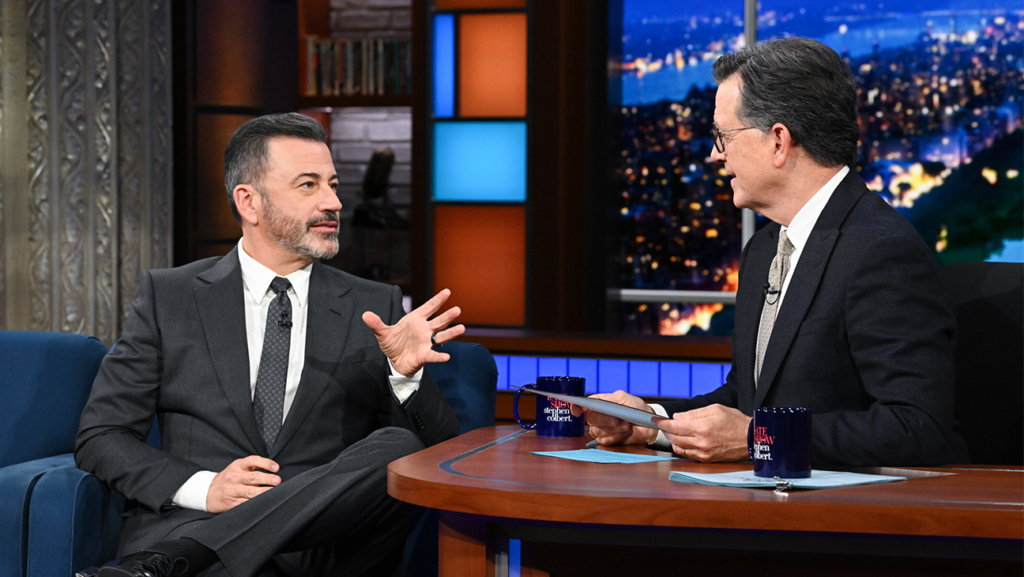
New York — Former President Donald Trump has spent years lashing out at late-night television, but his latest attempt to discredit Jimmy Kimmel appears to have produced a familiar outcome: renewed attention, amplified mockery and a coordinated response from the very hosts he sought to marginalize.
The episode began after Mr. Trump criticized Mr. Kimmel in public remarks and online posts, portraying the comedian as emblematic of what he has long described as a hostile entertainment establishment. The comments echoed earlier attacks in which Mr. Trump has accused late-night hosts of partisan bias and irrelevance.
Within hours, the critique became material.
On successive broadcasts of Jimmy Kimmel Live! and The Late Show with Stephen Colbert, Mr. Kimmel and Stephen Colbert addressed the attack directly, using extended monologues to frame Mr. Trump’s comments as evidence of thin-skinned intolerance for satire rather than substantive criticism.
The result was less a spontaneous joke than a carefully constructed counterpunch — one that underscored how adept late-night television has become at turning political pressure into content.
A Pattern Repeats Itself
Mr. Trump’s clashes with late-night comedy date back to the 2016 campaign, when hosts like Mr. Kimmel, Mr. Colbert and others began devoting sustained attention to his rhetoric and governing style. During his presidency, he repeatedly denounced comedians by name, at times demanding apologies or questioning why networks allowed them to air critical material.
Media analysts say the dynamic has rarely worked in his favor.
“Attacking a comedian is an invitation,” said Brian Stelter, a media analyst. “It signals that the jokes landed.”
In this case, the invitation was accepted swiftly and visibly.Mr. Kimmel’s monologue reframed Mr. Trump’s criticism as a badge of honor, arguing that satire is doing its job when it provokes anger from those in power. Mr. Colbert followed with a broader reflection on Mr. Trump’s relationship with television — a medium that helped make him famous and now serves as a persistent source of frustration.
Neither segment introduced new reporting or allegations. Instead, both relied on Mr. Trump’s own words, replayed and contextualized, a technique long favored by late-night hosts seeking to let subjects speak for themselves.
Studio audiences responded with sustained laughter and applause, moments that were quickly clipped and shared online, where the segments reached far beyond their original broadcasts.
Reaction and Silence
Mr. Trump did not issue a verified public response to the monologues. Allies dismissed the segments as predictable attacks from what they described as a liberal entertainment industry. Supporters online argued that the attention only proved Mr. Trump’s continued relevance.
The absence of a direct response, however, did little to slow the spread of the clips, which continued to circulate across platforms as examples of what fans described as a “late-night pile-on.Late-night television occupies an unusual position in American political life. It is not journalism, yet it frequently draws on journalism. It does not claim neutrality, yet it shapes perceptions — particularly among younger viewers less likely to watch cable news.
According to research from the Pew Research Center, a significant share of Americans under 40 say they encounter political information through entertainment programs, often before seeing it in traditional news formats.
“Comedy is a gateway,” said Dannagal Goldthwaite Young, a professor at the University of Delaware who studies political humor. “It lowers defenses.”
A Calculated Risk
For Mr. Trump, the episode illustrates the risks of confronting late-night hosts directly. Engaging can energize critics and extend coverage; ignoring them allows narratives to circulate unchallenged.
Former advisers say there is no perfect strategy.
“When you’re the subject of satire, every option has a downside,” said a former Trump communications aide. “The

Leave a Reply