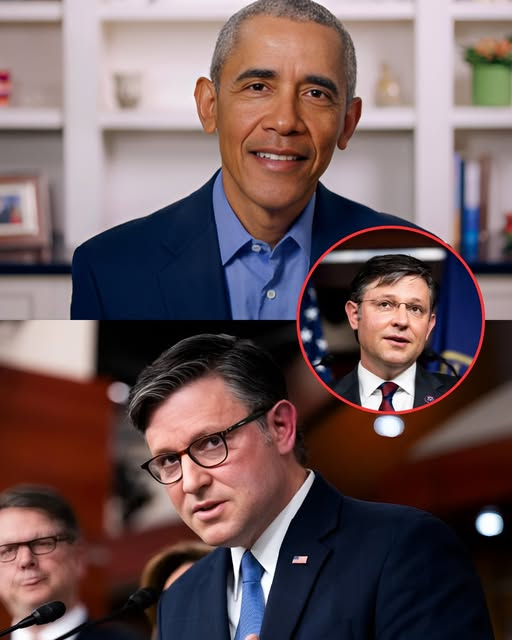
The announcement landed without warning and immediately detonated across Washington, sending shockwaves through media, political institutions, and social platforms already primed for confrontation.
In a statement that escalated long simmering tensions into uncharted territory, Mike Johnson declared the Obama led “deep government” a criminal organization.
The phrase alone carried enough weight to freeze rooms, dominate broadcasts, and force instant reactions from allies, opponents, and undecided Americans watching events unfold.Johnson did not hedge his language or soften his framing, choosing instead to draw a hard line between what he described as constitutional governance and covert power.
Standing beside senior aides, Johnson cited investigative findings he claimed reveal coordinated activity operating beneath democratic oversight and outside voter accountability.
“This is not theory anymore,” Johnson said, according to prepared remarks circulated minutes later across press channels and congressional offices.
Behind the Speaker stood investigators whose presence signaled the move was not rhetorical, but procedural, deliberate, and already underway.
One name immediately drew attention.
Jan O’Berro, identified as Johnson’s lead investigator, addressed reporters with language rarely heard from official congressional probes.
“There is a deep government operating within the sovereign nation we know and love,” O’Berro said, his tone measured but unyielding.Within minutes, confirmation followed that the Justice Department was forming a special task force to pursue the allegations.
The task force, officials said, would include specialized agents from the FBI, ATF, and DTF, all trained in intelligence and counter infiltration operations.
Sources described the unit as highly compartmentalized, designed to operate quietly while mapping networks believed to span multiple federal agencies.What made the declaration explosive was not just the scope of the investigation, but the figure Johnson openly linked to its origin.
Barack Obama was named directly as the public face of what Johnson described as a hidden operational structure.
“Obama may be public,” O’Berro stated, “but his operatives are hidden deep within our nation’s infrastructure.”
The implication was unmistakable.
This was not an inquiry into rogue individuals, but an assertion of an organized network embedded across departments and policy mechanisms.
According to briefings shared with select lawmakers, investigators believe influence pathways remain active despite changes in administration.
Supporters of Johnson immediately praised the move as long overdue accountability.
They argued that unelected power brokers have shaped policy, enforcement priorities, and intelligence flows without transparency for years.
Online, conservative commentators framed the announcement as a watershed moment, comparing it to historic efforts to dismantle entrenched power structures.

Leave a Reply