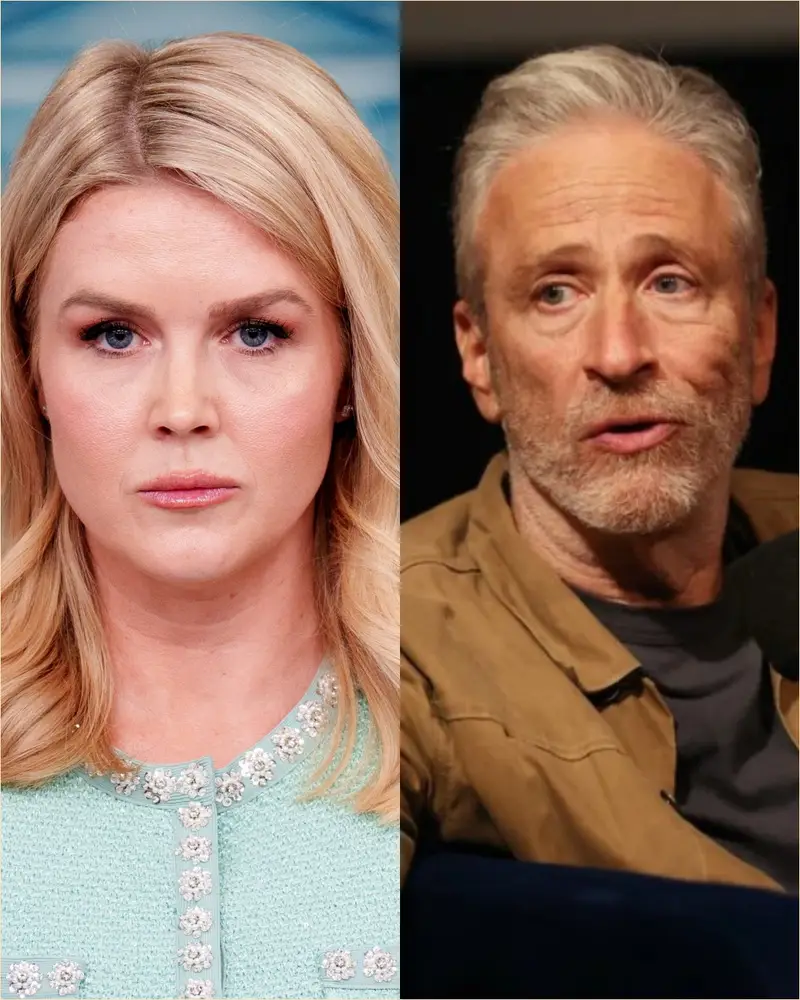
**“SIT DOWN, BABY GIRL”:
The Night Jon Stewart Allegedly Froze the Studio and Reminded America What Real Relevance Looks Like**
In an era where viral outrage travels faster than truth, one imagined moment on live television captures everything broken—and brilliant—about modern political media.
The studio lights felt harsher that night. Not physically, perhaps, but culturally—like they were interrogating everyone beneath them.
Karoline Leavitt had just finished speaking.
Her monologue was sharp, rehearsed, and unmistakably incendiary: a blistering takedown of what she called “out-of-touch celebrities who think they have the right to lecture America.” The words came fast, polished by repetition on podcasts, panels, and platforms where volume often substitutes for substance. She spoke with the confidence of someone who knows the algorithm is listening.

Across the table sat Jon Stewart.
No interruption. No trademark eye roll. No immediate punchline.
Just stillness.
For those who have followed Stewart’s decades-long career, that quiet was the warning sign. Jon Stewart, when silent, is never unarmed. He is calculating. Waiting. Letting momentum build before redirecting it—cleanly, surgically, and without raising his voice.
Mika Brzezinski noticed first.
She leaned forward slightly, the corners of her mouth curling into a knowing smile. Veteran instinct. She had seen this posture before—the calm before a rhetorical storm. Cameras adjusted. Producers likely held their breath.
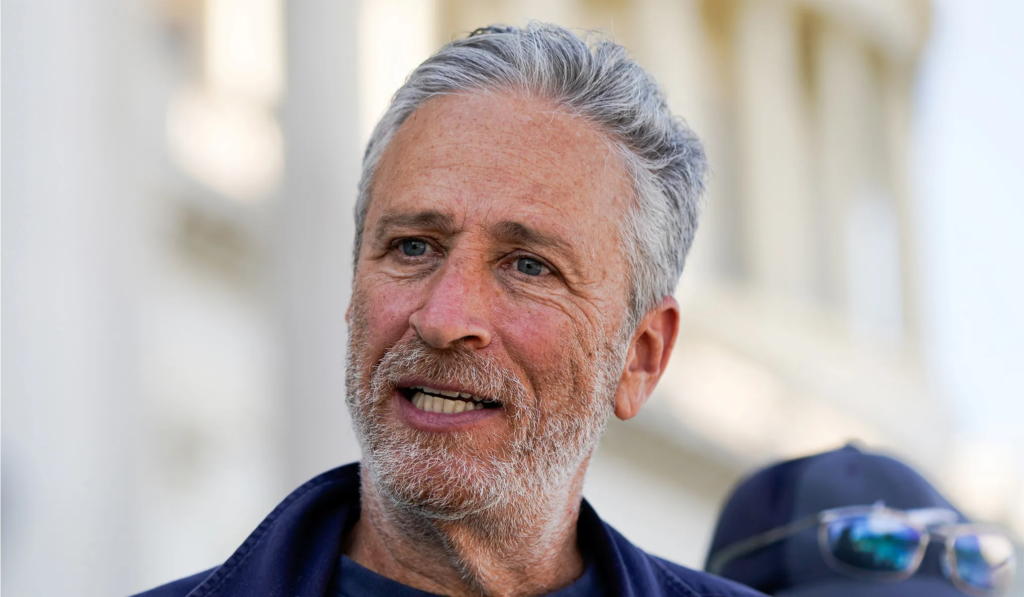
Then, with deliberate ease, he reached into his blazer pocket and pulled out a neatly folded piece of paper.
That’s when the room froze.
“Alright,” he said softly, his voice controlled but unmistakably sharp. “Let’s be honest for a moment, sweetheart.”
And then he began to read.
A Biography, Not a Breakdown
The paper wasn’t long. That was the point.
“Karoline Leavitt,” Jon read evenly. “Born 1997. Former White House assistant—tenure: eight months. I’ve hosted shows that lasted longer than that.”
A pause.
“Lost two congressional races—both by double digits.”
Another pause. Longer this time.
“Hosts a podcast with fewer weekly listeners than my dog’s Instagram account.”
The studio was silent now. Not the awkward kind. The dangerous kind.
“Preaches ‘free speech,’” he continued, “yet blocks anyone who challenges her.”
Cameras zoomed in. Mika’s eyebrows lifted, not in shock, but recognition. This wasn’t cruelty. This was contrast. Stewart wasn’t yelling. He wasn’t insulting. He was doing something far more devastating in modern media:
He was reading facts aloud.And her latest achievement?” Jon concluded. “Calling a man who has entertained millions for decades ‘irrelevant’—while she trends for all the wrong reasons.”
He folded the paper carefully and placed it on the table.The Power of Stillness
What made the moment—at least in this imagined telling—so electrifying wasn’t the content. It was the restraint.
In a media ecosystem addicted to shouting, Jon Stewart didn’t raise his voice. He lowered it.
He leaned forward, locking eyes across the table. When he spoke again, it wasn’t as a comedian. It wasn’t as a host. It was as a veteran of a cultural battlefield Karoline Leavitt had only recently entered.
“Baby girl,” he said calmly, “I’ve been performing, hosting, and connecting with audiences since before your parents went to prom.”
No laughter. No applause.
“I’ve faced critics louder, harsher, and far more relentless than anything you can fire off on social media.”
The words weren’t cruel. They were contextual. And context, in the attention economy, is lethal.
He paused.
“And yet—here I am. Still here. Still relevant. Still entertaining.”
A beat.

Leave a Reply